

Since January 1, 2026, PSA has dropped a bomb on the Hobby: the sacrosanct Gem Mint 10 now requires a centering of 55/45, burying the historical tolerance of 60/40. Facing this drastic tightening, naked-eye evaluation becomes a real financial suicide for your bulk shipments. Dive into the era of surgical pre-screening and the digital tools that will save your upcoming submissions.
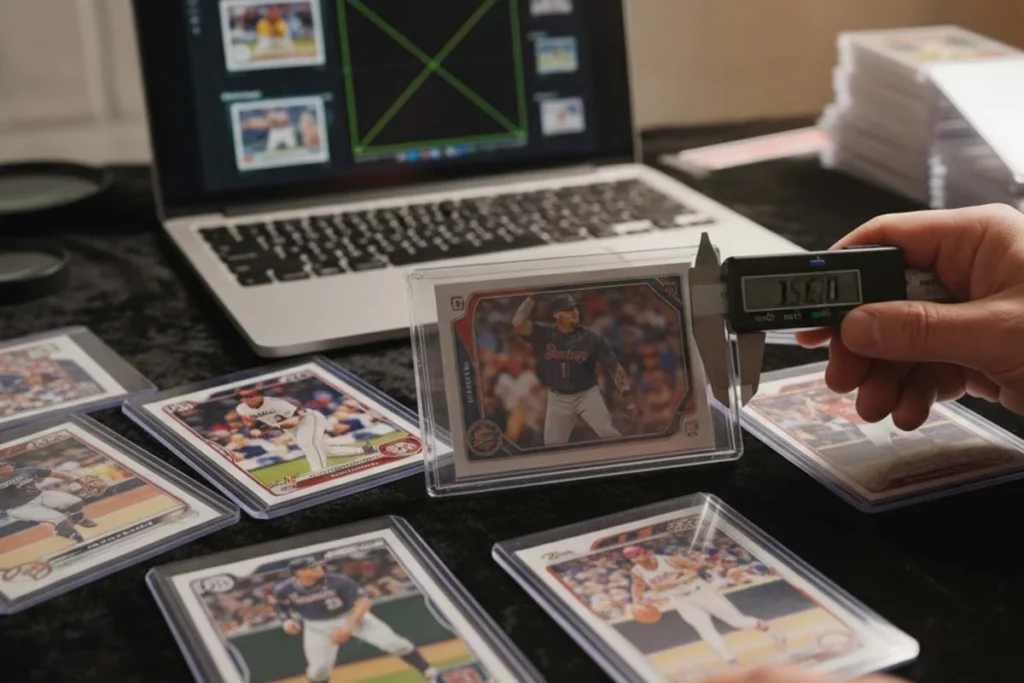
The rumor had been building since the last National, and it became reality in the small hours of January 1. PSA cut to the quick to restore the 10-grade’s nobility. Gone is the era when a visibly thicker left border slipped between the nets. The market was reaching saturation, flooded by slabs from the ultra-modern era with uncontrollable populations. By tightening the vise to 55/45, the grading leader performs a brutal but necessary pop control.
For the regular collector and the investor, the playing field changes radically. Sending a stack of a hundred raw cards freshly pulled from sleeves, trusting to your visual instinct, now guarantees a disastrous return, populated by PSA 9s that will struggle to cover your grading costs.
The End of Visual Indulgence
The human brain is a poor tool for geometric measurement. At 60/40, the centering shift jumps out to the eye of an experienced collector. At 55/45, the difference becomes almost imperceptible without a reference frame. This is where the trap closes on those who prepare their shipments by merely tilting the card under a halogen lamp.
Breakers continue to howl at a hit with each case opening, but the reality of resale has shifted. A raw card, even with razor-sharp corners and a pristine surface, will lose its upside potential if it shows a 56/44 ratio. The axe falls without appeal in the Newport Beach grading rooms.
The Numerical Impact: A Market Split in Two
The initial submission feedback at the start of this year paints a merciless picture. Series known for chronic cutting issues are undergoing a veritable massacre.
| Flagship Collection | Gem Rate Q4 2025 (Standard 60/40) | Gem Rate Q1 2026 (Standard 55/45) | Immediate PSA 9 Markdown |
|---|---|---|---|
| Panini Prizm NBA (Base Silver) | 64% | 38% | – 45% |
| Bowman Chrome Baseball (1st Auto) | 72% | 49% | – 30% |
| Topps Chrome UEFA (Refractor) | 59% | 31% | – 55% |
| Upper Deck Series 1 (Young Guns) | 68% | 44% | – 40% |
This table illustrates the collapse of Gem Rates. The artificially created rarity by PSA drives up the value of the new 10s, but sacrifices the 9s that now flood resale platforms at rock-bottom prices.
The Grader 2.0’s Arsenal
Resistance is organized around digitizing our routines. Jeweler’s loupes are still used to inspect the dimples or print-line defects, but centering requires mathematical rigor.
The Mandatory Flatbed Scan
Forget smartphone photos distorted by the wide-angle lens. The basic investment in 2026 is a flatbed scanner calibrated to at least 600 DPI. The card must be laid bare, without a penny sleeve, perfectly straight against the edges of the platen to guarantee perfect alignment. Any tilt will distort your pixel calculations.
The Pixel-Counting Method
Classic photo-editing software or hobby-dedicated apps (like OmniGrade or TrueCenter) incorporate millimeter overlay grids. The foolproof technique is to isolate the opposing borders.
Use the rectangular selection tool. Measure the width of the left border (e.g., 42 pixels) and that of the right border (e.g., 36 pixels). Add these two values to obtain the total space allocated to the borders (78 pixels). Divide the larger border by this total (42 / 78) and multiply by 100. You get a ratio of 53.8%. You are in the green for the 55/45.
If your calculation shows 55.5%, the card immediately joins the raw resale pile or heads to another grader less strict on this precise criterion.
Industrialize Your Pre-Screening
Processing a bulk shipment of 200 cards now requires military discipline. Create digital templates for your favorite sets. Complex designs without full borders (the famous borderless or cards with asymmetrical graphic elements) require identifying the anchor points PSA uses to evaluate centering. Look for logos, inner frames, or text lines that serve as factory-cut guides.
Don’t let hope dictate your margins anymore. The next big hit you’ll pull from a box will deserve this digital autopsy before boarding the plane. Take your scanner, calibrate your reading grids, and let the casino players clog PSA’s system with cards that no longer deserve the plastic in which they are sealed.