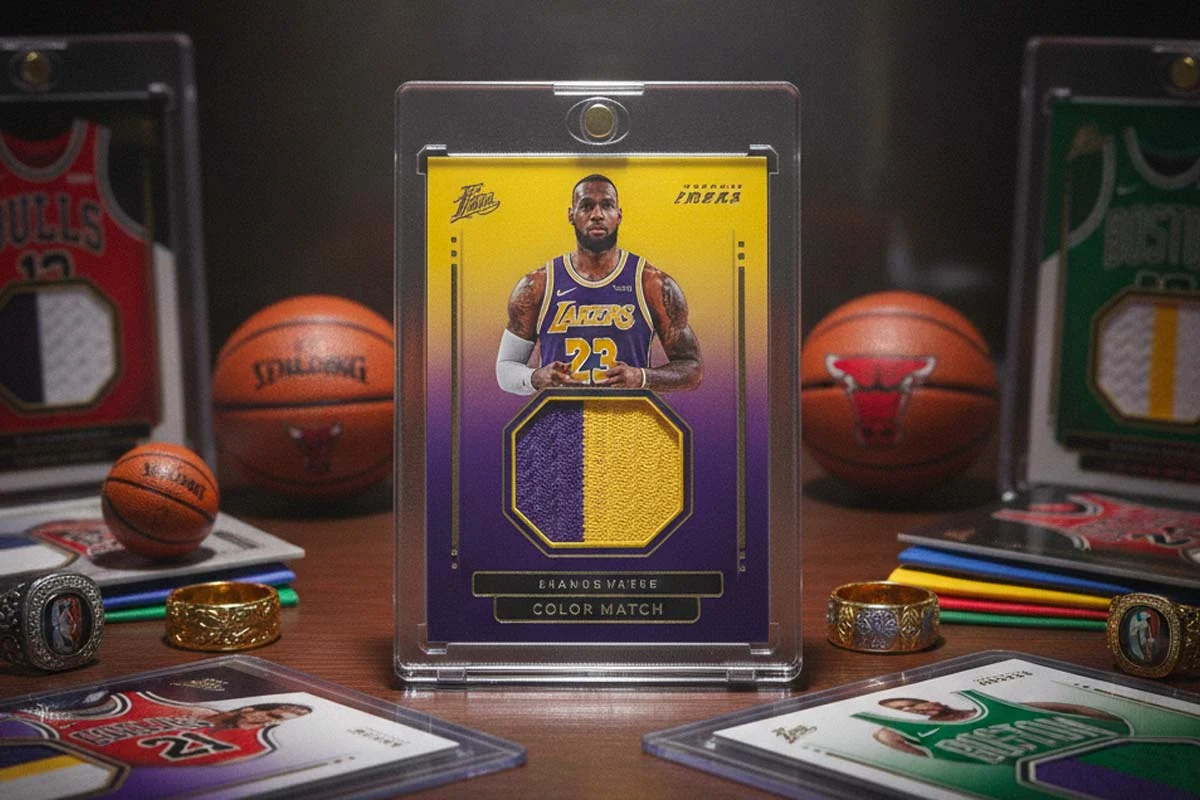

How much is this card found in a binder worth? Is the price requested by a seller reasonable? What price should you list a rookie, an autograph or a numbered parallel for?
Estimating the value of a sports card may seem simple: look up the player, find a few listings and compare prices. Yet two almost identical cards can have very different values. The set, version, condition and grading certification all affect which comparisons to use.
So the starting point is essential: the price shown in a listing is not necessarily the price a card sells for.
To get a credible estimate, you need to identify the card precisely, assess its condition and look for several comparable sales. Tools such as 130 Point, Card Ladder and eBay make this process easier, provided you understand the data they show.
1. Identify the card precisely
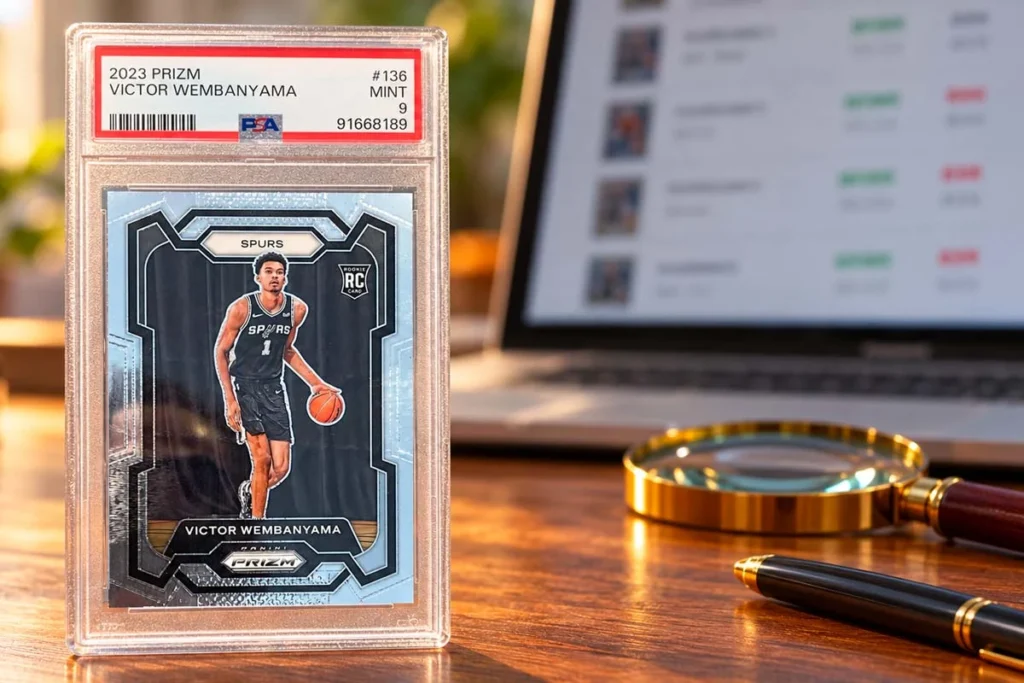
Before looking for a price, make sure you are searching for the right card. The player’s name and year are not always enough.
Note the following information:
- The player and sport.
- The year or season of the set.
- The brand and set: Topps Chrome, Panini Prizm, Upper Deck…
- The card number, usually shown on the back.
- The version: base, insert, parallel or variation.
- Any serial numbering: /199, /99, /25, /10, 1/1…
- Special features: autograph, patch, memorabilia.
- Any grading certification: grading company, grade and subgrades.
A base card and its Gold /10 parallel may share the same image, but they should be valued separately. Likewise, an autographed card and its unsigned version are not equivalent comparisons.
To identify a version, consult a checklist. Our NBA checklists can help you find sets, their inserts and parallels.
Then build your search using this formula:
Year + set + player + number + parallel + grading certification
The more precise your search, the less likely you are to mix up different cards.
2. Assess the card’s condition
Two copies of the same card can have significantly different prices because of their condition.
Examine the front and back under good lighting, checking four elements:
| Element | What to check |
|---|---|
| Corners | Wear, whitening, crushing |
| Edges | Chipping, marks, cutting defects |
| Surface | Scratches, creases, stains, marks |
| Centering | Balance of the image and borders |
On shiny cards, some scratches are only visible when you tilt the card. The back deserves just as much attention as the front.
A card pulled from a pack recently may have manufacturing defects. “Pack fresh” does not automatically mean “perfect” or “a future Gem Mint 10.”
For an ungraded card, describe any visible defects and look for sales of copies in similar condition. Avoid applying universal discounts: a defect does not affect every card in the same way.
Raw and graded cards: two different comparisons
A raw card is an ungraded card. A graded card has been examined and encapsulated by a grading company.
Where possible, compare:
- A raw card with raw cards in comparable condition.
- A PSA 9 with the same card in PSA 9.
- A BGS 9.5 with BGS 9.5 copies, checking the subgrades when available.
Do not assume that the same grade from two different companies will automatically result in the same price. Check sales for each grading certification.
3. Search for completed sales
Completed sales are generally the best starting point for estimating a card’s value. They show the amounts observed in transactions, while active listings show what sellers are asking.
A card listed for €200 may go a long time without finding a buyer. If several comparable copies sell for around €80, the €200 listing is not enough to justify that estimate.
For each result, check:
- The exact card and parallel.
- The condition or grade.
- The sale date.
- Whether other cards were included in a lot.
- The currency and shipping costs.
- The sale format: auction, fixed price or accepted offer.
For a card that trades regularly, prioritize recent sales. For a rare card, widen the time frame, bearing in mind that an older transaction may not reflect current demand as accurately.
Look for several comparisons. Three to five relevant sales can provide an initial benchmark when data is available. If you find only one, present your estimate with greater caution.
4. Which tools should you use to estimate a sports card?
Search tools do not all show the same information. Some record transactions, while others provide a price guide or calculate an estimated value.
A sale result, a guide price and an automated estimate should be treated as different things.
130 Point: find sales and accepted offers
130 Point lets you search sales across several platforms, including eBay and various auction houses.
It is particularly useful for finding comparisons and, when available, the negotiated amounts for sales where an offer was accepted. This amount may be lower than the original asking price.
Enter the full card details, then narrow the results using the available filters: date, platform, price, sale format or grading.
Review each result before using it. A search that is too broad may mix different parallels, graded cards and lots.
Main advantage: quickly search for comparable transactions.
Limitation: the available results do not necessarily represent every sale on the market.
Card Ladder: explore sales history and trends
Card Ladder offers a price guide, sales histories, indexes and collection-tracking tools.
Some features are available for free. Full sales histories and several advanced tools are included in the Pro plan.
Card Ladder helps you put an estimate in context over time: do the latest transactions converge around the same range? Is the observed price stable or highly variable?
It also provides calculated values, including CL Value. These amounts are still estimates: they do not necessarily correspond to a recent transaction for the specific card.
Main advantage: analyze sales history and track the performance of multiple cards.
Limitation: a calculated value should be checked against sales, especially when there are few comparable transactions.
eBay: check completed sales and set your price
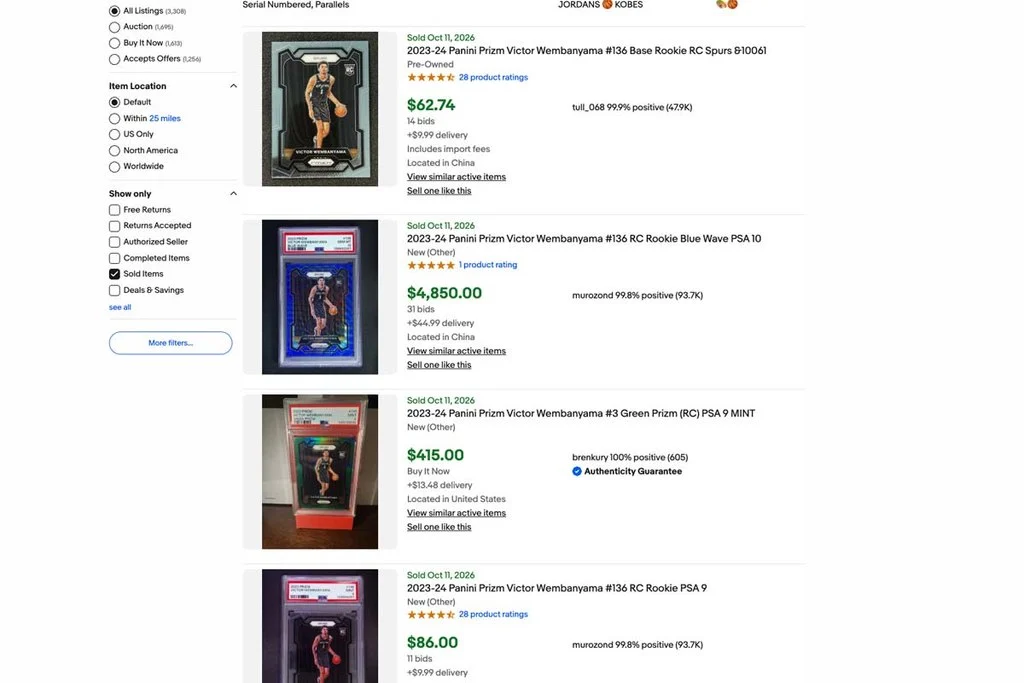
eBay lets you search sold items and review active listings.
The Product Research tool provides more detailed data (example for a Victor Wembanyama Panini Prizm rookie card), including the amounts actually negotiated when an offer was accepted and sales history going back up to three years.
Use sales to estimate value, then check active listings to see what you are competing with before listing your card.
Main advantage: compare transactions with cards currently listed.
Limitation: results may include similar but different cards. Also check that the listing actually resulted in a sale.
PSA: compare graded cards by grade
PSA offers two complementary resources:
- PSA Price Guide, for indicative prices.
- Auction Prices Realized, for searching sale results for PSA-certified cards.
These tools are useful for comparing a card by grade. For example, you can review sales in PSA 8, PSA 9 and PSA 10 separately.
Main advantage: find comparisons for a PSA-certified card.
Limitation: a guide price may differ from the latest transactions and may not account for every feature of an individual copy.
SportsCardsPro: get an initial benchmark
SportsCardsPro shows estimated prices, sales histories and charts for listed cards. Its values are calculated using recorded sales, particularly on eBay and its own marketplace.
It can help you quickly get a sense of a card’s value before examining the transactions used.
For ungraded cards, pay particular attention to the condition of the copies: the “Ungraded” category may include cards in varying condition.
Main advantage: get an initial estimate and review price trends.
Limitation: the accuracy of the figure depends on the sales selected and how they are classified.
Beckett: consult an additional price guide
Beckett Online Price Guide offers price guides and checklists for many sports, with subscription plans.
It can help identify a card and provide another benchmark. However, a Beckett price guide should be checked against recent transactions.
Main advantage: consult a price guide and information about sets.
Limitation: a guide price does not guarantee the amount a card will sell for.
Which tool should you choose?
| Your need | Useful tools |
|---|---|
| Find comparable sales | 130 Point, eBay, Card Ladder |
| Check an accepted offer | 130 Point when the amount is available, eBay Product Research |
| Study price trends | Card Ladder, SportsCardsPro |
| Compare PSA-graded copies | PSA Auction Prices Realized |
| Consult an additional price guide | Beckett, PSA Price Guide |
You do not need to use all these tools for every card. Start with comparable transactions, then dig deeper if the card is rare or the results differ.
Watch out for duplicates: an eBay sale found on 130 Point and Card Ladder is still just one transaction.
5. Understand rarity and demand
A low serial number may contribute to a card’s value, but it is not enough to determine its price.
A /10 card is not automatically more expensive than a /99 card featuring another player or from another set. Demand also plays a part.
Factors to consider include:
- The player and collectors’ interest in them.
- Whether the card in question is a rookie card.
- The set.
- The parallel and its serial numbering.
- The autograph and its characteristics.
- The type of memorabilia.
- The copy’s visual appeal.
- The availability of comparable cards.
A sticker autograph and an autograph signed directly on the card should be treated as different. For memorabilia, read the text on the back: game-worn, player-worn and non-associated describe different characteristics.
These features can affect demand, but their impact on price should be verified against sales.
A low population does not mean a low total print run
A population report shows the copies recorded by a grading company, broken down by grade.
A low PSA population therefore does not correspond to the total number of cards in existence. Other copies may remain ungraded or may have been certified by another company.
Use this information as one factor in your analysis, without automatically inferring a premium.
6. Estimate a card with no comparable sales
For a rare card, there may be no recent sale of the exact card available.
In that case, gradually broaden your search:
- An older sale of the same card.
- Another parallel of the same player from the same set.
- A similar card of the same player from a comparable set.
- Cards featuring players with similar levels of demand.
Each time you broaden the search, uncertainty increases. Explain which comparisons you used and provide a wider price range.
Avoid multiplying values based solely on print run: a /25 card is not automatically worth four times as much as a /100.
For a valuable card, multiple opinions from specialized professionals can supplement your research. Distinguish their estimate from a buyout offer, which takes their costs and margin into account.
7. Determine a realistic price range
Let’s take a hypothetical example: five comparable copies sold for €42, €45, €47, €49 and €72.
The median is €47: the middle value when the prices are sorted.
The €72 sale deserves a closer look. Was the copy in better condition? Were shipping costs included? Did it have a special feature? Was it simply an unusual transaction?
If the comparisons are relevant, the sales clustered between €42 and €49 provide an initial benchmark. You still need to account for your copy and the conditions under which you want to sell.
Do not automatically use the highest sale. Nor should you dismiss a result just because it does not match your expectations.
A sound estimate is a range that is explained, dated and based on identifiable comparisons.
8. Distinguish estimated value, asking price and net proceeds
These three amounts answer different questions:
- Estimated value: what range do comparable sales suggest?
- Asking price: what price do you want to list the card for?
- Net proceeds: how much will you receive after fees?
For a quick sale, you can choose a competitive price based on comparable sales and competing listings. If you are willing to wait, you may choose a different strategy, but that does not guarantee a buyer will pay more.
To calculate your net proceeds:
Net proceeds = sale price − commissions − shipping paid by you − other selling costs
When comparing international sales, check the currency, shipping costs and any import fees. Compare amounts on a consistent basis.
Common mistakes to avoid
An estimate becomes less reliable when you:
- Use only active listings.
- Confuse a base card with a parallel or variation.
- Compare a raw card with a graded card.
- Mix grades or grading companies.
- Ignore visible defects.
- Rely on an old sale without checking recent results.
- Count the same transaction multiple times.
- Treat an automated estimate as a guaranteed price.
- Infer value solely from the serial numbering.
Frequently asked questions
Can you estimate the value of a sports card for free?
Yes. Sales available on eBay, searches on 130 Point and some free resources can help you establish an initial estimate. Accuracy depends primarily on identifying the card correctly and finding good comparisons.
What is the best site for finding out how much a card is worth?
It depends on what you need. 130 Point and eBay are useful for finding sales. Card Ladder lets you explore sales history in greater depth. PSA provides comparisons for cards it has certified. No tool eliminates the need to check the card’s version and condition.
Do you need to get a card graded to find out what it is worth?
No. You can estimate the value of an ungraded card using comparable sales. Before considering grading, compare observed prices at different grades and factor in all costs without assuming what grade the card will receive.
Is an old card necessarily worth a lot?
No. Age should be considered alongside demand, availability, the set and condition.
Why do tools show different prices?
They may use different time periods, transactions or calculation methods. Before comparing figures, also check that they refer to the same version, grade and currency.
How can I tell if my estimate is reliable?
Your estimate is more reliable when several recent sales of the same version in comparable condition converge within a price range. When data is scarce or the copies differ from yours, express a lower level of confidence.
For your next estimate, keep a record of the exact card details, links to the sales you used, their dates and the characteristics of the copies. That way, you can support your price range and update it when new transactions appear.