

The thrill of imagining a lenient or tired grader on a Monday morning is over. With the mass deployment of Genamint technology announced for 2026, PSA is about to entrust the evaluation of our precious gems to artificial intelligence. The official promise from Nat Turner and his teams: clinical, constant precision, believed to eradicate disputes. In the aisles of card shows and on forums, anxiety is rising. Will automation kill the human dimension of the Hobby?
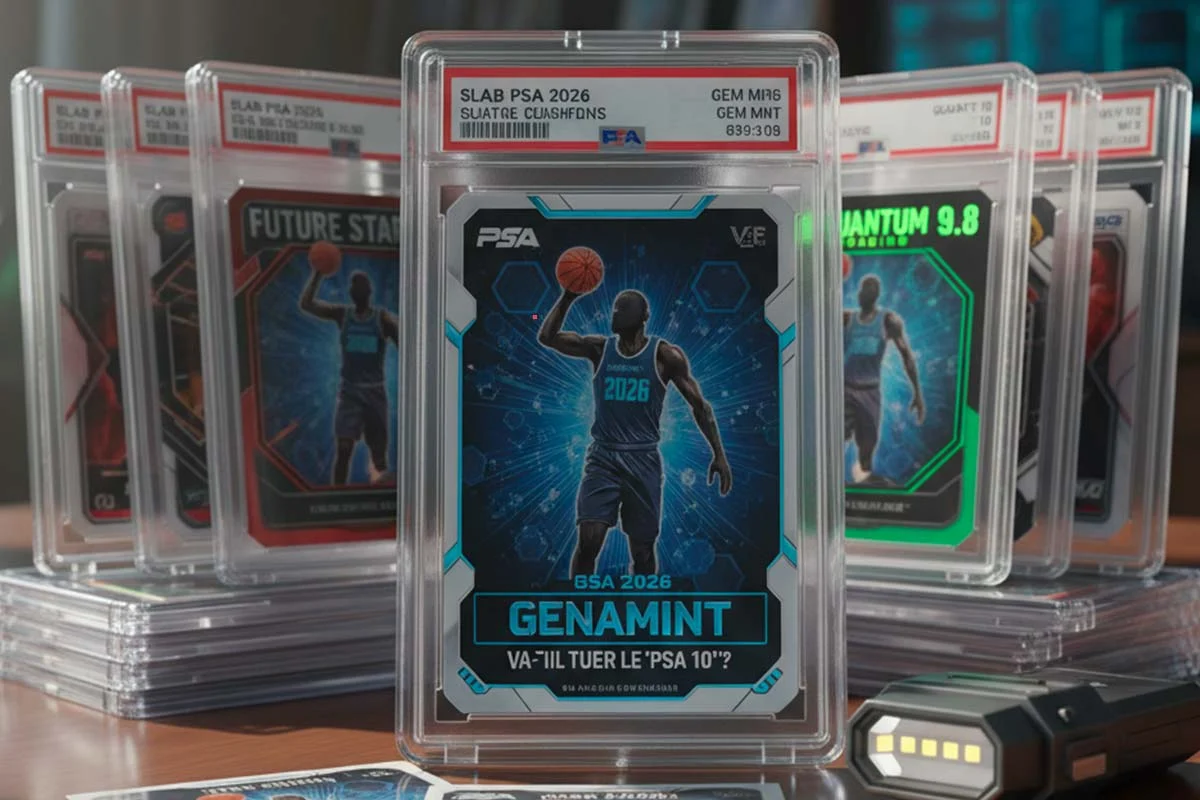
The end of indulgence and the triumph of the pixel
The ritual is embedded in the DNA of every collector. You pull a huge hit during a break, you protect the raw card with manic care, and you send it to California with the visceral hope of obtaining the famous PSA 10. Until now, this supreme grade rested on a fragile balance between strict criteria and the human eye — an eye that could be generous at 2 PM on a Wednesday or ruthless after a bad night.
The integration of Genamint sweeps away this subjectivity with a wave of the algorithm. Acquired by Collectors Universe, this computer-vision technology doesn’t look at your card: it scans it, maps it, and compares it instantly to a database of several million copies. Centering is no longer eyeballed; it is measured to the micron precision. Micro-scratches on a Prizm or Chrome surface, often invisible under standard lighting, are immediately betrayed by multi-band spectral analysis.
📡 What Genamint detects (and what the human eye doesn’t always see)
Centering deviations < 0.5 mm · Micro-abrasions on Chrome and Prizm finishes · Chromatic fade of autograph inks · Print defects (print lines, color bleeding) · Micro-chips on corners invisible · Flatness variations (millimetric warping)
This algorithmic rigor poses a major philosophical problem. Grading has always been a matter of compromise. A slight surface defect could be forgiven if the corners were razor-sharp and the centering perfect — which created the famous “gem mint appeal”. The machine, it does not negotiate. It applies a mathematical, weighted, indisputable penalty.
This is not merely an upgrade of tools: it’s a complete paradigm shift. For decades, the value of a PSA 10 was also built on the idea that a qualified human had looked this card in the eye and judged it perfect. Tomorrow, it will be a digital signature.
The specter of the “Pop Control” and the opacity of judgment
The main worry of investors lies in Genamint’s impact on the Pop Reports. If AI becomes the sole arbiter in 2026, the conversion rate to PSA 10 on ultra-modern, highly sensitive series — Panini Noir, Topps Chrome Sapphire, National Treasures — could collapse. Early internal simulations point to rejection rates up to 30 to 40% higher than those observed today.
Some are already shouting about institutionalized “Pop Control”: by making PSA 10 rarer mechanically, PSA would consolidate the value of its most sought-after certifications. A thesis that Collectors Universe refutes, but that secondary market numbers could quickly validate.
⚠️ The problem of subgrades
Unlike BGS or CGC — where the collector analyzes the detailed score by category (Centering, Corners, Edges, Surface) — the PSA system post-Genamint risks functioning as a total black box. You would receive a PSA 9 with no exploitable justification, because an algorithm detected a deviation of 0.2 mm on the left border. Without subgrades, there is no rational contestation possible.
Old Slabs (graded pre-2026)
These certifications represent human judgment in its purest form, with its biases and conceded indulgences. For vintage in particular, these “old-school” slabs could see their market premium soar structurally.
AI Slabs (graded post-2026)
Theoretically more reliable and reproducible, but rarer in PSA 10. The central question will be: will the market prefer objective rigor or the nostalgia of human judgment? The first two years after deployment will be decisive.
Projected impact on the secondary market
| Category | Before 2026 | Post-Genamint | Estimated impact |
|---|---|---|---|
| Vintage (Pre-1980) | Leniency on centering and surface | Strict algorithmic penalty | 📈 Increase in older PSA 9 & 10 |
| Ultra-Modern Chrome | Visual bias on micro-scratches | Laser detection of surface defects | 📉 Drop in Gem Mint rate |
| On-Card Autographs | Overall signature evaluation | Pixel-perfect fading analysis | 📉 Depreciation of imperfect signatures |
| TCG (Pokémon / Magic) | Tolerance on print lines | Systematic identification of defects | 📈 Increased rarity of PSA 10 |
| Refractors & Prizms | Visual analysis under direct light | Spectral scan of the refractive layer | ⚡ High volatility expected |
The impact on the “Crack & Resubmit”
The technique of crack and resubmit — breaking open the case of a severe PSA 9 to retry — will become a calculated financial suicide. Genamint operates with an absolute photographic memory: it recognizes the card’s unique fingerprint (cardboard fibers, holographic pattern, micro-manufacturing defects). You can crack the holder and resubmit the card a year later: the algorithm will identify it and return the same analysis.
💡 What this changes concretely
The “lottery submit” that made fortunes for many flippers will disappear. Human variance — that forgiving Friday-afternoon grader — was embedded in the strategies of many hobby investors. The crack-and-resubmit market on premium vintage could lose 60 to 70% of its economic logic.
Ce que PSA ne dit pas : les zones d’ombre

The vintage card problem
Pre-1980 cards were produced with radically different printing tolerances. How will Genamint modulate its criteria depending on the production era? The answer to this question will be decisive for the premium vintage market.
The training bias of the algorithm
If Genamint’s database over-represents modern series (Topps, Panini) at the expense of foreign productions (Japanese BBM, regional editions), collectors of these niches could face inconsistent evaluations.
What about contestation?
PSA has a “review” process for challenged cards. Does this human process survive the Genamint era? The lack of a clear answer may be the most anxiety-inducing aspect for collectors who invest substantial sums in their submissions.
Adaptive strategy: the savvy collector’s guide
-
01
Invest in your pre-grading tools 10x minimum loupe (ideally 30x), UV lamp, millimeter-centering gauges. Pre-grading will become a science in its own right — those who train now will have a decisive edge.
-
02
Secure your high-grade vintage Old Slabs Don’t give in to the temptation of cracking open a “vintage” PSA 9 or PSA 10 graded by humans. Their historical value, coupled with the leniency of a bygone era, will appreciate structurally.
-
03
Apply the rule: doubt = do not submit If you have the slightest doubt about a corner, a surface or centering, the post-Genamint machine will say no with mathematical certainty. Reserve your submissions for pieces you are absolutely convinced about.
-
04
Reassess crack-and-resubmit now If you have PSA 9 cards to crack, act before full deployment. Once AI is in place, the card’s memory will be permanent. Timing is counted in months, not years.
-
05
Monitor Pop Reports in real time Identify now your positions on series with low Pop Reports — their value could explode if Genamint blocks conversion of new cards to PSA 10.
An inevitable revolution — prepare now
Genamint is neither an enemy nor a savior of the Hobby: it is a structural transformation that will redistribute value across the entire market. Collectors who anticipate it correctly — by securing their Old Slabs, hardening their selection criteria, abandoning variance strategies — will come out ahead.
The machine of 2026 no longer operates on sentiment. It only reads data. The only good answer is to learn to speak its language before it’s too late.