
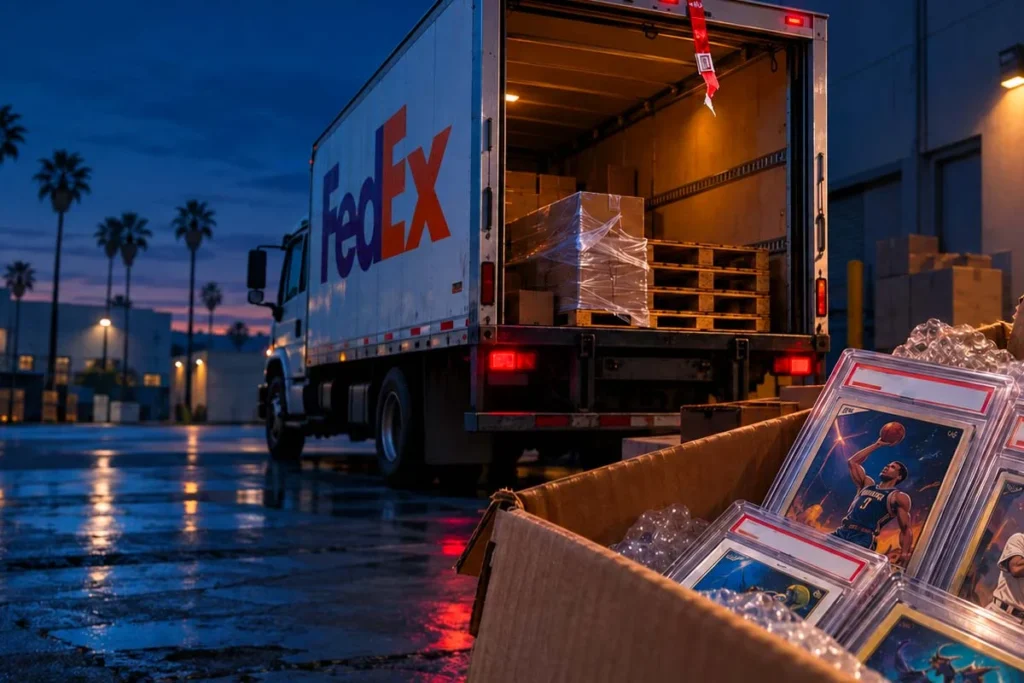
On October 13, 2026, a theft of trading cards was reported to the Santa Ana Police Department in California. Two pallets were stolen from a FedEx vehicle carrying cards that had just been graded by PSA, and a third was affected. The shipment included Pokémon cards, as well as sports cards being returned to their owners after the grading process.
Collectors, PSA’s parent company, has confirmed the theft and announced that the affected certificates would be deactivated, along with a compensation process. The case, initially widely shared in trading card game communities, is a reminder that sports card collections are also at risk.
Collector reports 104 missing cards
Content creator SKY-B made the case public on October 17, explaining that his submission of 104 cards, which he values at more than $100,000, had been stolen.
This figure comes from his account. It is neither an independent valuation of his collection nor the total loss from the theft.
Other owners subsequently shared their experiences. Among the reported items was a Smaug the Magnificent from Magic: The Gathering, graded PSA 9. Reports also involve Pokémon and Yu-Gi-Oh!.
These posts put a human face on the case, but they do not constitute a comprehensive list of the missing cards. They also show what the figures leave out: the research, discussions, and decisions that come before sending a collection for grading.
Sports cards are also vulnerable to theft
Theft cases covered in the hobby often highlight Pokémon cards and other TCGs, or trading card games. Their visibility can give the impression that the problem mainly affects these communities.
The presence of sports cards in this shipment is a reminder that the risk cuts across categories. A rare Pokémon card, an NBA autograph, or a baseball rookie card can all move through the same shipping, grading, and resale channels.
However, it would be premature to present this incident as proof of a general increase in sports card thefts. The available information does not allow us to measure such a trend or claim that the thieves were targeting a particular category.
The takeaway is still striking: when a shipment consolidates orders from many collectors, a single theft can affect several communities at once. In that situation, the distinction between sports cards and trading cards matters less than their presence in the same shipment.
PSA deactivates certificates for stolen items
Collectors says it is working with law enforcement and the carrier. The company says it has taken three steps:
- Deactivate the certificates associated with the stolen items.
- Alert partner platforms, particularly to help identify rare and serial-numbered items.
- Contact affected customers to arrange compensation.
Deactivating a certificate flags the issue in the verification system. However, it does not change the physical holder or the label attached to the card.
For serial-numbered cards, the number printed on the card itself provides another identifying detail. Along with photographs and the certification number, it can help identify an item if it resurfaces in a listing.
Alerting market participants is therefore an important step. The goal is to limit the circulation of stolen items while preserving the details that can help identify them.
Compensation is not simply the amount stated by the owner
Collectors says compensation will be based on fair market value. The email shared by SKY-B specifies that it is capped at the Maximum Insured Value, or MIV, applicable to each card.
These two concepts serve different purposes:
| Concept | Role in compensation |
|---|---|
| Fair market value | The value assigned to the card when calculating compensation |
| Maximum Insured Value | The coverage limit associated with the applicable service level |
According to PSA’s published terms, compensation is limited to the lower of these two amounts. The coverage limit is therefore not an amount that is automatically paid out.
Comparisons become central to the process: edition, serial number, grade, and completed sales must be considered together to document a card’s value. This is where the difference between asking prices and actual sale prices comes in, as explained in our guide to estimating the price of a sports card.
As of October 20, 2026, some owners are publicly discussing the offers they have received. These accounts are not yet enough to draw a general conclusion about how all claims will be settled.
A theft that affects collectors’ trust
For the victims, grading was complete. All that remained was to receive their cards, see them encased, and add them to their collections. It was this final step that was interrupted.
The case highlights a vulnerable point in the journey cards take: being consolidated for shipment. Even when each owner sends only a few items, bringing them together can make the consequences of a single incident considerable.
Sports cards are also affected by this vulnerability. While this theft is not enough to establish a general trend, it broadens the focus beyond cases typically associated with TCGs.
The next developments people are waiting for concern the investigation, the recovery of the items, and the handling of affected owners’ claims. For them, getting a card back would be different from simply receiving compensation for its market value: a card chosen and kept for years cannot always be replaced with another copy.