
In 1993, a Fleer designer decided that lightning was a sufficient color palette. The card that emerged from it — the Scoring Kings Michael Jordan — still takes your breath away at the bottom of a top-loader today. Thirty years later, in a market saturated with numbered parallels that all look the same, this singular card is worth more than it ever has. It is not a coincidence.
The 1990s constitute the only decade in which sports-card manufacturers were truly compelled to innovate — or risk disappearing. The Junk Wax Era of the 1980s, characterized by massive overproduction, had left millions of cards with no value in the hands of disappointed collectors. The market demanded something else. The responses offered by Fleer, SkyBox, Upper Deck and their design teams constitute today the reference corpus for any serious investor in the hobby.
This dossier is not a simple buying guide. It is a chronological and technical reconstruction of an era whose artifacts continue to dictate the rules of the current market. We will dissect the houses, the sets, the manufacturing techniques, the mechanics of organic rarity and the dynamics of long-term valuation — with the level of precision demanded by a seasoned investor.
« A 90s card isn’t cheap because it is rare. It is rare because it was almost impossible to obtain one in perfect condition. »
— Fundamental axiom of vintage grading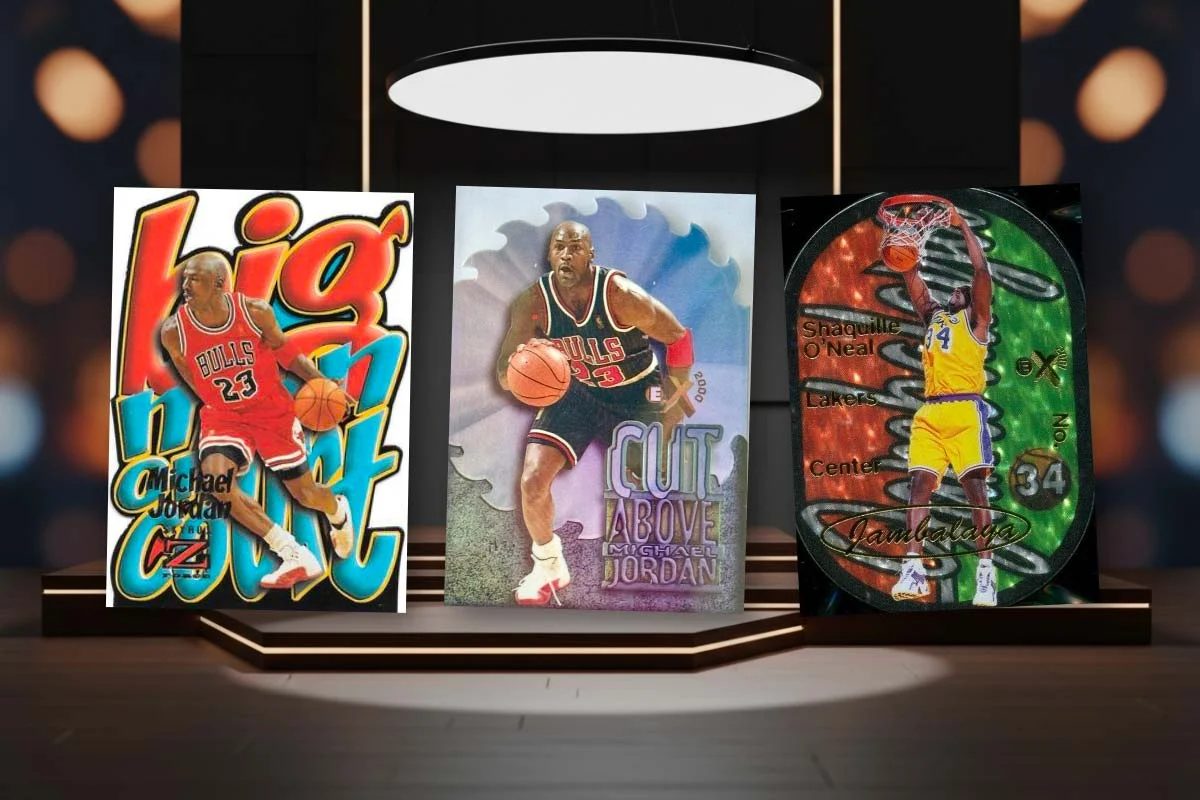
The Context: From Junk Wax to the Design Revolution
To understand why the 90s inserts are what they are, you have to go back to the catastrophe that preceded them. Between 1986 and 1992, the publishers — Topps at the helm, followed by Donruss and Fleer — printed cards in industrial quantities, convinced that collectors’ demand was inexhaustible. This calculation proved disastrous.
Billions of cards flooded the market. Hobby shops ordered them by the case, dealers speculated on print runs that were worth nothing. When the bubble burst in the early 1990s, collectors’ confidence was in ruins. The message was clear: rarity by itself is not enough if everyone can print at will. The market demanded structural rarity, embedded in the manufacturing process, and impossible to counterfeit.
1992–1993 : Upper Deck opens the breach
It was Upper Deck that, as early as 1989, introduced the idea that manufacturing quality could be an argument. Their coated paper, their professional photography, the anti-counterfeit hologram on the back — so many innovations that repositioned the sports card as a premium object. But it was in 1992-93, with the first full NBA season after the “Dream Team”, that the market experienced its real turning point.
Demand exploded around a few players: Michael Jordan, Shaquille O’Neal (rookie), Charles Barkley, Patrick Ewing. Upper Deck answered by launching the first modern inserts of the era: cards included at a lower ratio in packs, on a different stock, with a design radically different from the base. The hunt for the “hit” was born.
1993–1994 : Fleer Ultra redefines what is possible
The 1993-94 year is the one when everything shifts. Fleer launches its Ultra line with an unprecedented editorial ambition: inserts that have nothing to do with ordinary baseball cards. The All-NBA, the Power in the Key and especially the legendary Scoring Kings immediately prove themselves as aesthetic references.
What distinguishes Fleer Ultra at this time is the conceptual coherence. Each insert set tells a visual story: the action, the dominance, the physical power of NBA players. The metallic foil is not applied as decoration — it structures the composition, creates contrasts that render the photography more dramatic. These cards looked like nothing that existed before them.
Junk Wax Era
Massive overproduction. Billions of cards with no value. Collectors’ confidence collapses. The market demands a radical break.
Birth of Inserts
Upper Deck invents print-run ratios. Fleer Ultra popularizes metallic foil. The notion of a “hit” enters the hobby’s vocabulary.
Golden Age of Design
SkyBox, Metal Universe, Finest, E-X2000: manufacturers wage a creativity war. Die-cuts, acetate, holograms — the insert becomes art.
Peak & Consolidation
Print runs reach the absurd (1:720). Upper Deck buys out rivals. The market contracts — but the centerpiece pieces of this era enter into legend.
The Engineering of Desire: how these cards were made
Behind every iconic 90s insert hides a manufacturing process that editor technical teams developed, sometimes patented, and jealously guarded. Understanding these techniques is not just a historian’s exercise — it is what allows evaluating the difficulty of obtaining a specimen in perfect condition, and thus calibrating one’s grade expectations.
The metallic foil (Holographic Foil Stamping)
The dominant technique of the early-to-mid-90s. An ultra-thin metal film — usually aluminum vapor-deposited on a polyester support — is heat-sealed onto the coated paper under pressure and heat. The result is this iridescent, reflective surface that gives the Scoring Kings or SkyBox Showdown their immediate visual signature.
The problem for grading: the foil is extraordinarily sensitive to scratches, humidity, and temperature variations. The slightest rubbing between two cards in a 1990s kid’s binder leaves an irreversible white mark — the chipping phenomenon, the grader’s nightmare. It is precisely for this reason that PSA 10s on these sets remain exceedingly rare.
The die-cut (laser-cut)
Appearing massively in 1994-95, die-cut involves cutting the card along a non-rectangular outline — following the profile of a player, a logo, or an elaborate geometric shape. SP by Upper Deck (1995-96) with its Holoviews die-cut is the best-known example. The cut was performed by mechanical pressure or, in premium editions, by laser.
The cut edges are the first victims of time. A sharply cut corner poorly protected, a corner slightly compressed in its original packaging — and the grade drops by two points right away. Die-cut sets structurally exhibit the harshest pop reports: PSA 9s are already considered excellent examples.
Acetate and transparency (E-X2000)
The great innovation from Upper Deck for the E-X2000 line starting in 1996: replacing the standard cardboard with a transparent acetate backing (a rigid plastic similar to glass) for certain inserts. The card becomes literally translucent — you can see through it. The visual effect is striking; conservation difficulties are just as significant.
Acetate scratches easily, warps with heat, and presents surface problems that PSA and BGS graders evaluate differently from standard paper cards. It is a substrate that requires particular expertise when buying raw.
Foil thickness
The typical thickness of the metallic film on a 90s foil insert. Sufficient to reflect light, insufficient to withstand rubbing.
Press temperature
Approximate temperature of the foil heat-press. Too hot = bubbles. Too cold = delamination. Quality varied by workshop.
Printing process
A premium 90s foil insert typically went through the machine 4 to 6 times: base offset printing, then foil, then varnish, then die-cut.
The Production Houses: in-depth portraits
Four entities dominated the production of 90s NBA inserts. Each developed a recognizable editorial identity, distinctive manufacturing processes, and its own rarity strategy. Knowing them in detail means you can instantly identify a card in a loose lot — and assess its potential.
Fleer / Fleer Ultra
1886–2005Founded in 1886, Fleer is the oldest American sports-card company. Its Ultra line, launched in 1991 in baseball before reaching basketball, represents their most ambitious premium repositioning attempt. The Fleer Ultra approach is essentially photographic: striking images, dramatic compositions, foil work that serves the staging rather than supplanting it.
Fleer Ultra inserts are among the most accessible in PSA 8 grade, making them excellent entry points for the intermediate investor. PSA 9 and 10 on the foil sets (Scoring Kings, Jam Session, All-NBA) remain, nevertheless, absolutely rare due to systematic chipping problems.
- Scoring Kings1993–941:36 packs
- Jam Session1993–941:12 packs
- All-Defensive1994–951:18 packs
- Ultra Platinum1994–951:48 packs
- Quick Picks1995–961:20 packs
SkyBox International
1990–1999SkyBox is the house that pushed design the furthest into eccentricity. Founded in 1990 and bought by Marvel Entertainment in 1995 (then by Upper Deck in 1999), SkyBox operated for much of its existence as a graphic-design laboratory applied to sports cards. Their creative teams came partly from the video game world and comic-book illustration — and you can see it.
The most collectible SkyBox series are those from the Z-Force line (launched 1996-97) and the Showdown of the 1993–95 period. Their aesthetic — aggressive geometries, expressionist typography, color palettes that defy logic — is perfectly dated and that is precisely what makes it fascinating. SkyBox is to the 1990s what Memphis Group is to furniture design: excessive, coherent, unforgettable.
- Showdown Series1993–941:24 packs
- SkyBox Premium USA1994–951:36 packs
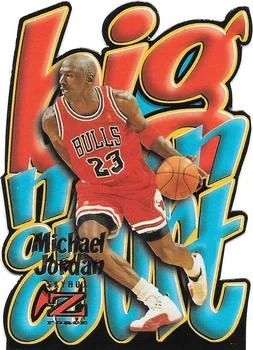
- Z-Force Big Men on Court1996–971:240 packs
- Z-Force Boss1997–981:120 packs
- Rubies (parallèles)1997–981:36 packs
Metal Universe (Fleer/SkyBox)
1996–1999Metal Universe is probably the most audacious series ever produced in the history of sports cards. Launched in 1996-97, it represents the apex of 90s maximalism: entire cards covered in chrome foil with allegorical illustrations depicting players in sci-fi, mythological, or cosmic realms. A Kobe Bryant floating in space. A Shaquille O’Neal as a Greek god of Olympus.
The Planet Metal (1997-98) set constitutes the absolute pinnacle. Printed at about 1:72 packs on average, with a foil-on-foil design on both faces, it presents an infinitesimal PSA 10 rate. Perfectly centered, with no chipping and intact foil, are absolute rarities that continue to climb on the secondary market.
Metal Universe also had the merit of popularizing the concept of a “base card premium”: even the base cards of the collection were more beautiful than most competitors’ inserts. This created a rare editorial coherence in the hobby of the time.
- Metal Universe (base)1996–97Set de base premium
- Precious Metal Gems (PMG)1997–981:72 packs (green) / 1:288 (red)
- Planet Metal1997–981:72 packs
- Universal Gravity1997–981:36 packs
- Linchpins1998–991:48 packs
E-X2000 (Upper Deck / Fleer)
1996–2001E-X2000 represents the most radically “material” approach of the decade. Where its competitors competed in graphic effects on cardboard, E-X2000 rethought the substrate itself. Translucent acetate base cards, extreme die-cuts on inserts, stratospheric print runs — everything in E-X2000 was designed to create objects of desire that would physically stand out from anything that existed in a collection.
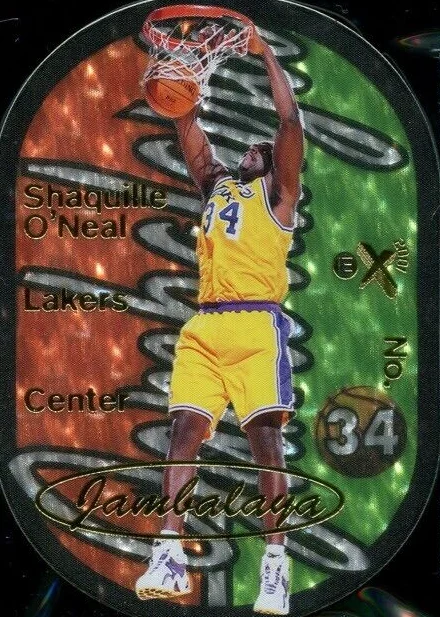
The Jambalaya set (1997-98) is the ultimate card of this universe. A ratio of 1:720 packs — the equivalent of three full boxes — on a die-cut design that features the faces of superstars cut into a chrome background. Finding a Jordan Jambalaya in PSA 9 in a box was an event hobby shops would display on the wall for weeks. These cards are today the Everest of the NBA vintage collection.
- E-X2000 (base, acetate)1996–97Set de base acetate
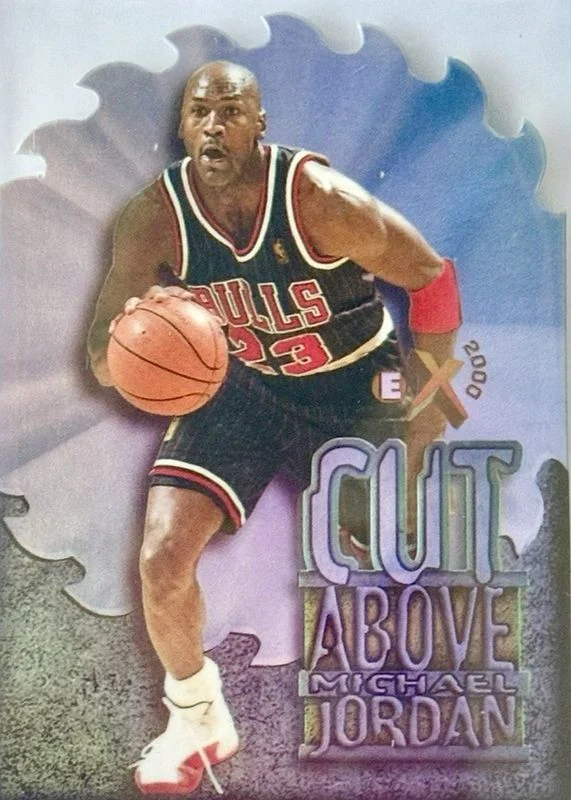
- A Cut Above1996–971:288 packs
- Jambalaya1997–981:720 packs
- Credentials1997–981:288 packs
- Essential Credentials Now/Future1998–99Numbered /499 and /499
The Mechanics of Organic Rarity: Thinking in Probabilities
The fundamental distinction between the inserts of the 90s and modern parallels lies in the very nature of their rarity. Understanding this distinction is essential for anyone looking to invest intelligently in vintage NBA.
Modern parallels (Prizm, Select, Optic) operate on a model of declared rarity: a number is printed on the back of the card, and that number defines the rarity. A card numbered /10 is rare because it is written that it is. Rarity is textual information, verifiable, but completely artificial.
The inserts of the 90s operate on a model of structural rarity: rarity is embedded in the production and distribution process. An insert pulled at 1:72 packs in a 36-pack box means that on average you must open two boxes to find one. It is not a back-of-the-card promise — it is a mathematical reality arising from the packing process. No one can cheat with this kind of rarity.
The invention of the ratio
Upper Deck introduces the first inserts with declared print-run ratios on the packaging. 1:6 packs, 1:12 packs. The concept is still benign — you understand that the card is “more rare” than the base, without rarity yet being an event.
The rise to extremes
Competition between publishers pushes the ratios upward. Fleer, SkyBox and Upper Deck outbid one another: 1:36, 1:72, 1:120. Finding an insert in a box becomes an event. Hobby shops begin displaying hits found on boxes.
The stratosphere of ratios
SkyBox Z-Force Big Men on Court: 1:240 packs. E-X2000 A Cut Above: 1:288 packs. Ratios that require buying multiple boxes to hope for a copy. The notion of a “case hit” enters the hobby’s vocabulary.
The absolute peak: 1:720 packs
E-X2000 Jambalaya reaches a ratio that has never been equaled in the hobby’s history: 1 copy for 720 packs opened, the equivalent of 20 boxes or 3 full cases. Some distributors have never seen a Jambalaya in their lives despite years in the hobby.
The contraction and numbering
Facing market fatigue, publishers begin to introduce printed numbering — first as a supplement to ratios, then as a substitute. The investment model shifts: we move from organic rarity to declared rarity. It’s the end of an era.
« You knew the card was unobtainable not because an arbitrary number claimed it, but because you had bled your pocket money in hobby shops without ever seeing it. »
— The difference between organic rarity and synthetic rarityThe Precious Metal Gems: the case study of combined rarity
A particularly instructive example of the 90s rarity mechanics: the Precious Metal Gems (PMG) from the Metal Universe 1997-98 series. This parallels set offers two versions — the green (around 100 copies per player, inserted at 1:72 packs) and the red (about 10 copies per player, at 1:288 packs).
This is an interesting case because it combines the two models: approximate numbering (there is no printed number, the print runs are estimated based on manufacturers’ statements and pop reports) and structural rarity via the ratios. The result? An extremely active collecting market, prices that regularly spike at auctions, and a hunter community fully dedicated to completing PMG rainbows of their favorite players.
Market valuations and piece hierarchy
The estimates below are based on sales observed in 2024-2025 on eBay, PWCC Marketplace and Heritage Auctions. Raw prices assume a Near Mint (NM) condition upon visual inspection. PSA slabs reflect actual sale prices, not asking prices. The vintage NBA market is active but volatile — these data are indicative.
| Set (season) | Player | Ratio | Raw NM | PSA 8 | PSA 9 |
|---|---|---|---|---|---|
| E-X2000 Jambalaya1997–98 · Die-cut acetate | Michael Jordan | 1:720 | ~15 000 $ | ~35 000 $ | ~65 000 $ |
| Fleer Ultra Scoring Kings1993–94 · Foil métal | Michael Jordan | 1:36 | ~400 $ | ~900 $ | ~1 800 $ |
| Metal Universe Planet Metal1997–98 · Foil double face | Kobe Bryant | 1:72 | ~350 $ | ~800 $ | ~1 500 $ |
| Metal Universe PMG Vert1997–98 · ~100 ex. par joueur | Kobe Bryant | 1:72 | ~8 000 $ | ~18 000 $ | ~40 000 $ |
| SkyBox Z-Force Big Men on Court1996–97 · Foil die-cut | Shaquille O’Neal | 1:240 | ~250 $ | ~600 $ | ~1 200 $ |
| SP Holoviews Die-Cut1995–96 · Upper Deck SP | Penny Hardaway | 1:75 | ~150 $ | ~400 $ | ~800 $ |
| Finest Refractor1993–94 · Topps Finest | Michael Jordan | 1:48 | ~3 500 $ | ~9 000 $ | ~22 000 $ |
| SkyBox E-X2000 A Cut Above1996–97 · Acétate die-cut | Michael Jordan | 1:288 | ~2 000 $ | ~5 500 $ | ~12 000 $ |
† Golden line = Holy Grail absolu du vintage NBA — the Jordan Jambalaya PSA 9 is one of the most sought-after cards in the global hobby across all categories. · PSA 10 prices exist but are so rare that they fall into an anecdotal exception rather than an organized market.
The Art of Grading on Vintage: Reading a Card Like an Expert
Grading 90s NBA inserts is a discipline in itself, significantly different from grading modern cards. The special surfaces (foil, acetate, die-cut) require a particular reading grid that any serious investor must master before buying raw.
The scale of grades in a vintage context
Chipping visible
Sweet spot
Exceptional
Quasi-mythical
On foil inserts from the 90s, PSA 8 is the sweet spot for the rational investor. It represents a copy in very good condition, with perhaps a minor edge wear or near-invisible micro-chipping, but visually impeccable. The price/quality ratio is generally optimal: PSA 9 commands a premium of 80 to 150% depending on the sets, but their presence in pop reports is often 70–80% lower than PSA 8.
Les cinq points d’inspection critique en raw
Before purchasing a 90s raw insert, systematically inspect these five areas with a loupe (minimum ×10):
Les quatre coins
On a foil inserts, look for the white points characteristic of chipping. On a die-cut, verify that the cut edges are intact and without compression. The bottom-right corner is statistically the most exposed during storage.
Alignment
PSA measures centering in ratios (60/40, 70/30…). On complex foil inserts, poor centering is common because the foil deformed slightly under the press. A 55/45 is acceptable; beyond 60/40, the grade drops mechanically.
Foil integrity
Observe the foil surface under grazing light, slowly turning the card. Surface scratches appear as clear lines on the metallic background. A single cross-cut scratch can drop the grade by two points.
Edges
The edges of foil cards accumulate deposits and micro-scratches. A clean edge, without roller marks (circular traces left by packaging machines), is a strong positive signal for the final grade.
The back of the card
The back is often neglected during raw inspection. Yet PSA grades both sides. Check for absence of writing, adhesive traces (tape remnants from binders), and discoloration. The backs of the 90s yellowed sometimes on poorly stored stock.
Specific to E-X2000
For acetate cards, look for diagonal scratches that appear under bright light. Acetate also develops micro-fissures at the corners with age. A slightly warped backing will systematically be noted below 8.
Pop Reports : comprendre et utiliser les données PSA
The PSA Pop Report — public database listing all graded copies by grade — is the most valuable tool for the vintage card investor. On 90s inserts, it often reveals counter-intuitive situations that directly influence buying strategy.
Concrete example: the Fleer Ultra Scoring Kings Jordan 93-94 shows a Pop Report where PSA 8 (around 180 copies recorded) are three times more numerous than PSA 9 (around 55 copies). Above that, PSA 10s are counted on the fingers of one hand. This asymmetric distribution, typical of foil inserts of the era, implies that the value jump between PSA 8 and PSA 9 is disproportionate relative to the real visual difference between the two grades.
The optimal strategy for most 90s foil sets is therefore to target high-quality PSA 8s (“High 8” in the jargon) — cards that scored an 8 for a minor flaw but whose overall appearance rivals a 9. These copies have the best risk/reward ratio in the long term, as they remain accessible while benefiting from the slab premium and the physical protection the holder provides.
Acquisition Strategy: think ten years, not ten months
Investing in 90s NBA inserts is not a short-term strategy. Unlike the modern rookie market, which can surge in a matter of weeks around a player’s season, 90s vintage follows longer cycles, driven by waves of generational nostalgia and market events (anniversaries, films, deaths, Hall of Fame inductions).
Core drivers of long-term valuation
Three structural forces support the long-term value of 90s NBA inserts, regardless of short-term fluctuations:
The aging of the Millennial generation. The generation that grew up with these cards — born between 1980 and 1995 — is now at the peak of its purchasing power. Nostalgia is a powerful and measurable economic engine. Record eBay sales in recent years coincide exactly with this demographic.
Inelasticity of supply. Unlike modern cards whose future stock can reasonably be estimated (Panini and Topps still print), the total stock of 90s inserts is fixed and can only decrease. Each poorly stored, lost, or destroyed copy permanently reduces the available supply. The graded supply, however, increases — but slowly, and PSA 9+ will remain structurally rare.
The cultural legitimacy of vintage sport. The Jordan-Pippen era is the best-documented, most mythologized, and most publicly exploited period in basketball history. The Last Dance (2020) provided a brilliant demonstration of this effect: Jordan insert prices rose 40 to 200% in the weeks following the broadcast. Similar events (biopics, anniversaries, new generations of players who cite Jordan as an influence) will provide regular catalysts.
Investment hierarchy by budget level
Here is a pragmatic tiered approach, based on market liquidity and observed valuation potential:
Budget < $500 : Fleer Ultra Scoring Kings Jordan 8, SkyBox Showdown from the 93-95 era in PSA 8-9 on secondary players (Penny Hardaway, Gary Payton, Vin Baker). These pieces offer exposure to the vintage segment with no major liquidity risk.
Budget $500–$2,000 : Metal Universe Planet Metal Kobe Bryant in PSA 8, SP Holoviews die-cut in PSA 9 on superstars, Topps Finest Refractor 1993-94 in PSA 7-8. The sweet spot of the risk/return ratio in the current secondary market.
Budget $2,000–$10,000 : Metal Universe PMG Green in PSA 7-8, E-X2000 Credentials Jordan in PSA 8, Fleer Ultra Scoring Kings PSA 9. Pieces with strong identity, with an established collector community and regular auctions that create liquidity.
Budget $10,000+ : The Jordan Jambalaya territory (all grades), the PMG Red, and PSA 9+ on major rarities. These are investments with a minimum 5–10 year horizon, with limited liquidity but potentially spectacular upside around market events.
The card that stands the test of time
90s NBA inserts are not a trend. They are objects that have survived three decades of inflation, economic crises, passing hobby fashions, and competition from digital formats. Their current valuation is not market luck — it is the belated recognition of a time when design, structural rarity, and high-quality manufacturing came together to produce truly irreplaceable objects.
Investing in these cards is betting on the nostalgia of a generation still gaining purchasing power, on the absolute inelasticity of a stock that can only become scarcer, and on the objective beauty of objects designed at a time when designers still had the freedom to take risks.
Buy the best. Protect them. Wait.
Dossier written for myhobbyroom.cars · Sources: PSA Pop Report (consulted Q1 2025), eBay completed sales 2023–2025, PWCC Marketplace auction results, Heritage Auctions NBA archives · Price estimates are indicative and reflect observed trends, not guarantees of future valuation · Any investment decision remains at the buyer’s discretion.