
It’s the seismic event rocking the Hobby in September 2026. Two Topps Chrome Black cards of Spurs phenom Dylan Harper, displaying exactly the same serial number 2/10 and two clearly different signatures, have been certified by PSA. Printing error or ultra-sophisticated counterfeit? A full recap and analysis of this major authentication crisis.
The Shock: One Serial Number, Two Cards, Two Slabs
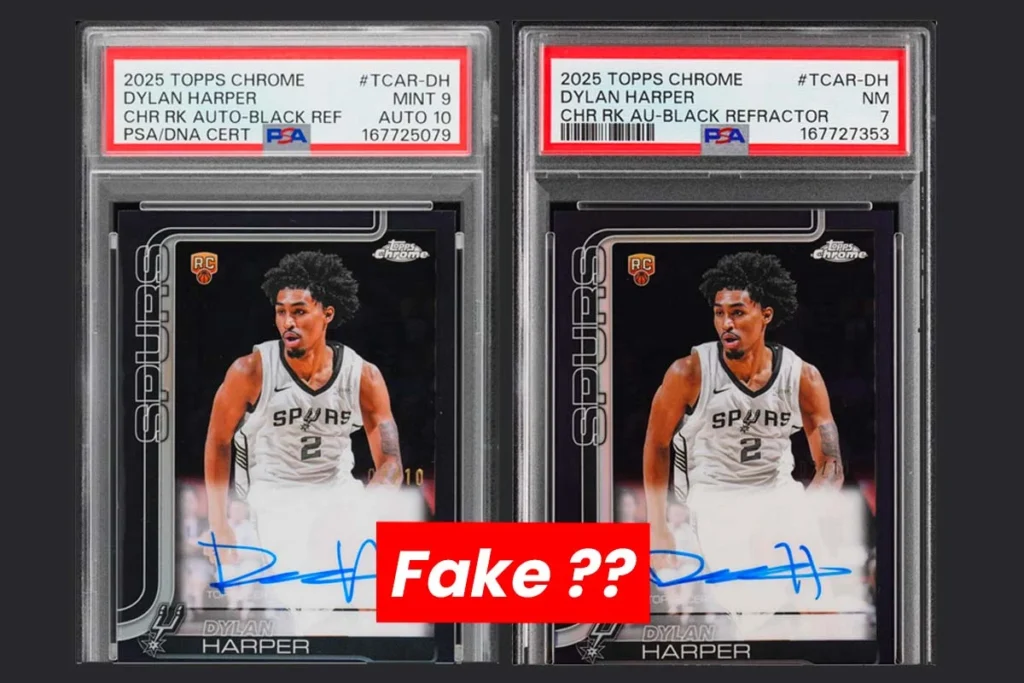
The 2026 season will be remembered by collectors for very bad reasons. It all began when vigilant members of the community spotted on social networks and specialized forums two copies of the same Dylan Harper card, the Spurs’ young star. It is the 2025 Topps Chrome Black Rookie Autograph in its Black Refractor variant, an extremely coveted parallel and theoretically limited to only 10 copies worldwide.
The problem? The two cards proudly bear the handwritten numbering 2/10. More worryingly, they are both sealed in a PSA slab with official and distinct certification numbers: Cert #167725079 and Cert #167727353.
Upon inspecting the two slabs, doubt sets in immediately. Not only does the overall visual appearance show slight tonal differences, but Dylan Harper’s signature differs drastically between the two copies. The stroke of the letters, the marker’s attack angles, the pressure on the card: it is evident that two different hands have signed these pieces of cardboard.
A Systemic Crisis: the Topps Chrome “Duplicates” Epidemic
This Harper case is unfortunately not an isolated event. For several weeks, the Hobby has faced an abnormal proliferation of double-numbered cards. Several major market players, including the DC Sports auction giant, had to urgently pull dozens of suspect auctions after discovering blatant duplicates.
| Player | Card / Set | Serial Number | Anomaly Observed |
|---|---|---|---|
| Dylan Harper | 2025 Topps Chrome Black Rookie Auto | 2/10 | Two different signatures, two distinct PSA certs (#167725079 and #167727353) |
| Victor Wembanyama | 2025-26 Topps Chrome Red Refractor | 5/5 | Two identical copies in circulation |
| Stephen Curry | 2025-26 Topps Chrome Red Refractor | 5/5 | Two copies with the same numbering |
This situation casts a polar chill over the market for high-value modern cards, where artificial rarity guaranteed by the serial number is the main engine driving prices.
Factory error, backdoor or counterfeit? The three theories
Faced with this anomaly, three scenarios are pitted against each other within the community.
1. Ultra-sophisticated counterfeit (The Fake)
It is the theory favored by many market experts. Thanks to phenomenal advances in printing technologies and holographic effect replication (notably the refractor technologies), foreign-based forgery networks manage to clone existing high-end cards. They copy a legitimate serial number already listed in PSA’s database and recreate a physical card. If this theory proves true, it would mean that one of the two Dylan Harper cards is a perfect fake that has managed to fool PSA experts.
2. Factory theft and “Backdoor” copies
Another possibility concerns internal leaks at Topps’ subcontractors. Uncut sheets of cards, or even test copies (“proofs”) normally destined to be destroyed, may have been stolen. These blank cards, devoid of any official signature, would then have been signed post hoc by a third party (or via the transfer of a peeled autograph sticker from a lower-value card) before being sent to grading.
3. Topps’ manufacturing error
And what if Topps simply got its wires crossed in its production chain? With the surge in print volumes for the 2025-26 basketball sets, the American giant’s quality control is under fire. A misfeed on the hot-stamping machines could very well have stamped the number “2/10” on several successive printing sheets, creating true factory twins later sent to the player’s autograph.
PSA Facing Its Responsibilities
Beyond Topps’ responsibility, it’s PSA’s reputation that wobbles. How could the world-leading certification authority have granted its precious label to two cards displaying the same serial number for such a limited print run (/10), without any alert being triggered in its computer system?
This case highlights PSA’s database vulnerabilities. Currently, a researcher or grader analyses a card in isolation without necessarily cross-referencing data in real time with other copies already labeled in the registry. For a market worth billions of dollars, this security flaw is seen as unacceptable by investors.
How to Navigate This Storm?
For collectors, caution is now the watchword. If you target high-end numbered cards (notably from Dylan Harper, Victor Wembanyama, or Stephen Curry Topps Chrome releases), apply these survival rules:
- Systematically verify the PSA registry: Do not just look at the slab. Enter the certification number on PSA’s official site and carefully compare the photos in the database (if available) with the card in your hands.
- Analyze the signature: Compare the autograph of the card in question with other certified and recognized copies of the same series. Suspect variations in style or marker thickness should raise a red flag.
- Buy from reputable sources: Favor sellers or platforms with strict return policies and solid authenticity guarantees. If in doubt, pass on it, no matter how attractive the price may be.
This Dylan Harper duplicates case marks a turning point. It will inevitably force Topps and PSA to revisit their security and control protocols, because without absolute trust in a card’s rarity, the entire Hobby ecosystem risks collapsing.